
Blog, Policy hub
New research maps the support systems landscape for young people in England
Dec 15, 25
Dec 15, 25

Last week we welcomed the Government’s National Youth Strategy, and announcements on an expanded employment support programme and rebalancing the apprenticeship system towards young people.
Individually these policies are very welcome, bolstering the UK’s youth offer. Together they lay the foundation for a cross-Whitehall commitment to turning the tide on youth unemployment and inactivity.
Taking a systems-change approach to youth employment requires an understanding of how young people currently receive and interact with support as they transition through education and training into work. This is particularly important for young people from marginalised groups, who we know from our research are more likely to become NEET.
New research, commissioned by Youth Futures and conducted by the Institute for Employment Studies, maps government-funded education-to-employment transitions support at national, regional and local levels in England.
It focuses on young people with:
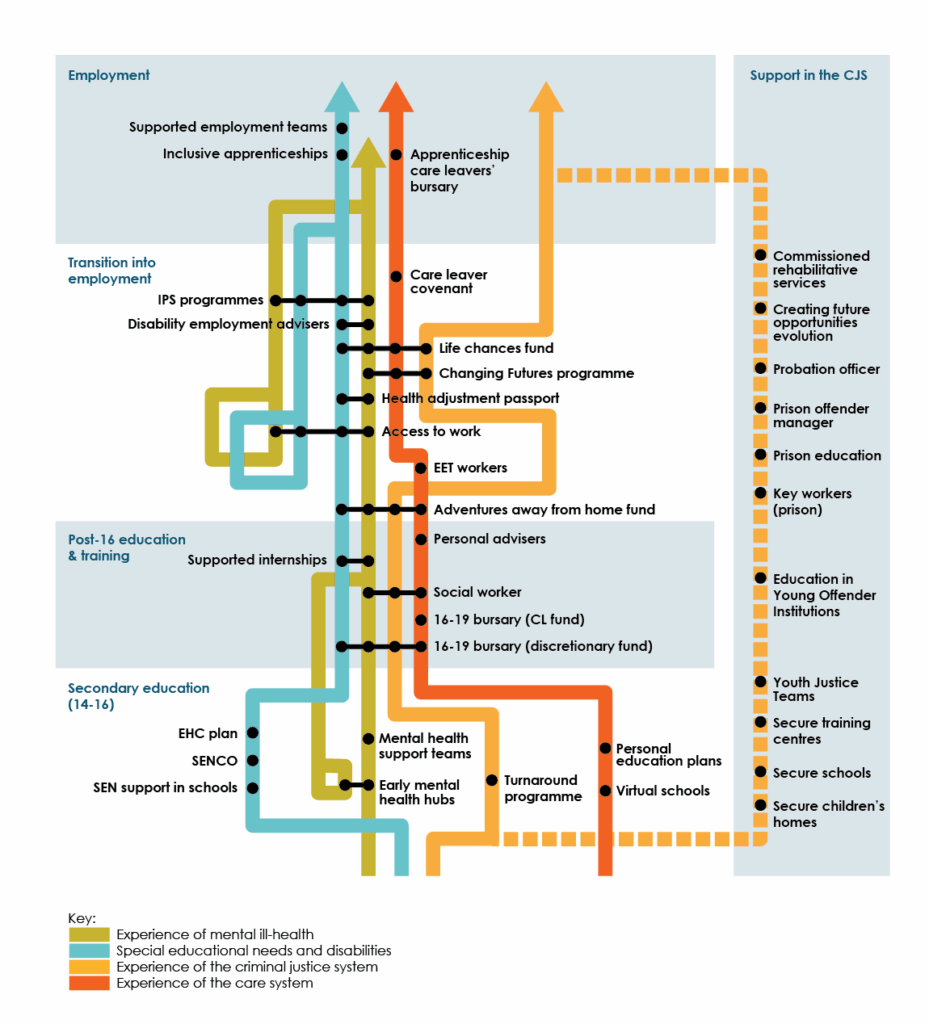
Mapping support in this way paints a picture of:
The research identified gaps in provision primarily due to:
The findings highlight the complexity of the support landscape in England that young people along with their families and carers must navigate, and which support services must effectively signpost to.
The research concludes with guidance for policy makers to balance locally adaptive solutions with consistency at the national level. It identifies that a national strategy enabled by youth voice and local leadership are key to overcoming the complexity and fragmentation illustrated in this project.
It’s positive to see that the government have already made a promising start through place-based approaches with the Youth Guarantee Trailblazers, and by putting youth voice at the centre of policy making through the Youth Guarantee Advisory Panel and in the National Youth Strategy.
With a stubbornly high NEET rate, challenging job market and rising mental ill health in young people, there will be a continued need for the UK to address gaps in provision and ensure greater stability and consistency in the support system.
This requires an evidence-based and integrated public policy agenda built holistically around young people, with both a universal youth employment offer and additional targeted support for those who need it the most.
Our Youth Employment 2025 Outlook offers a road map, identifying the need for:
One enabler of connecting more young people into the support they need is through the role of trusted adults. In our report The Missing Link we highlight the potential of trusted adult relationships to identify, reach and engage those furthest from the system and connect them into evidence-based interventions.
It is positive to see that in the National Youth strategy, the role of Trusted Adults is placed front and centre. Trusted adults and the relational support they provide can act as the ‘connective tissue’ of a strong youth offer.
Investing in cohesive, sustainable youth employment support now will generate long-term returns.
Our analysis suggests if the UK matched the Netherlands’ youth participation rate by 2050 – where just 1 in 20 young people are NEET – the economic and social gains would be substantial. Approximately 567,000 more young people would be in work or education, boosting the economy by £86 billion long-term.
We are encouraged to see government’s ongoing focus on addressing the NEET challenge. We are looking forward to engaging with the Investigation into Young People and Work, led by Alan Milburn, and with the sector to find evidence-based solutions and champion a systems-change approach to support more young people into good work.