Download
Authors

Lorraine Lanceley,Alexandra Nancarrow,Joy Williams, Billy Campbell, Joseph Cook, Louisa Illidge, Kevin Wong

Partners
https://youthfuturesfoundation.org/wp-content/uploads/2025/04/Institute-for-Employment-Studies-logo.png
Institute for Employment Studies (IES)

What Works: testing youth employment interventions  · 

View bio
Institute for Employment Studies (IES)
Research & evaluation partner

ProgrammeWhat Works: testing youth employment interventions

StatusActive

View partner View bio

About

IES is a leading independent centre for research and evidence-based consultancy in the UK. It specialises in employment, labour market and human resource policy and practice.

Its mission is to help bring about sustainable improvements in employment policy and human resource management by increasing the understanding and improving the practice of key decision makers in policy bodies and employing organisations.

Overview

We wanted to better understand the experiences of marginalised young people as they transition from education and training into good work.

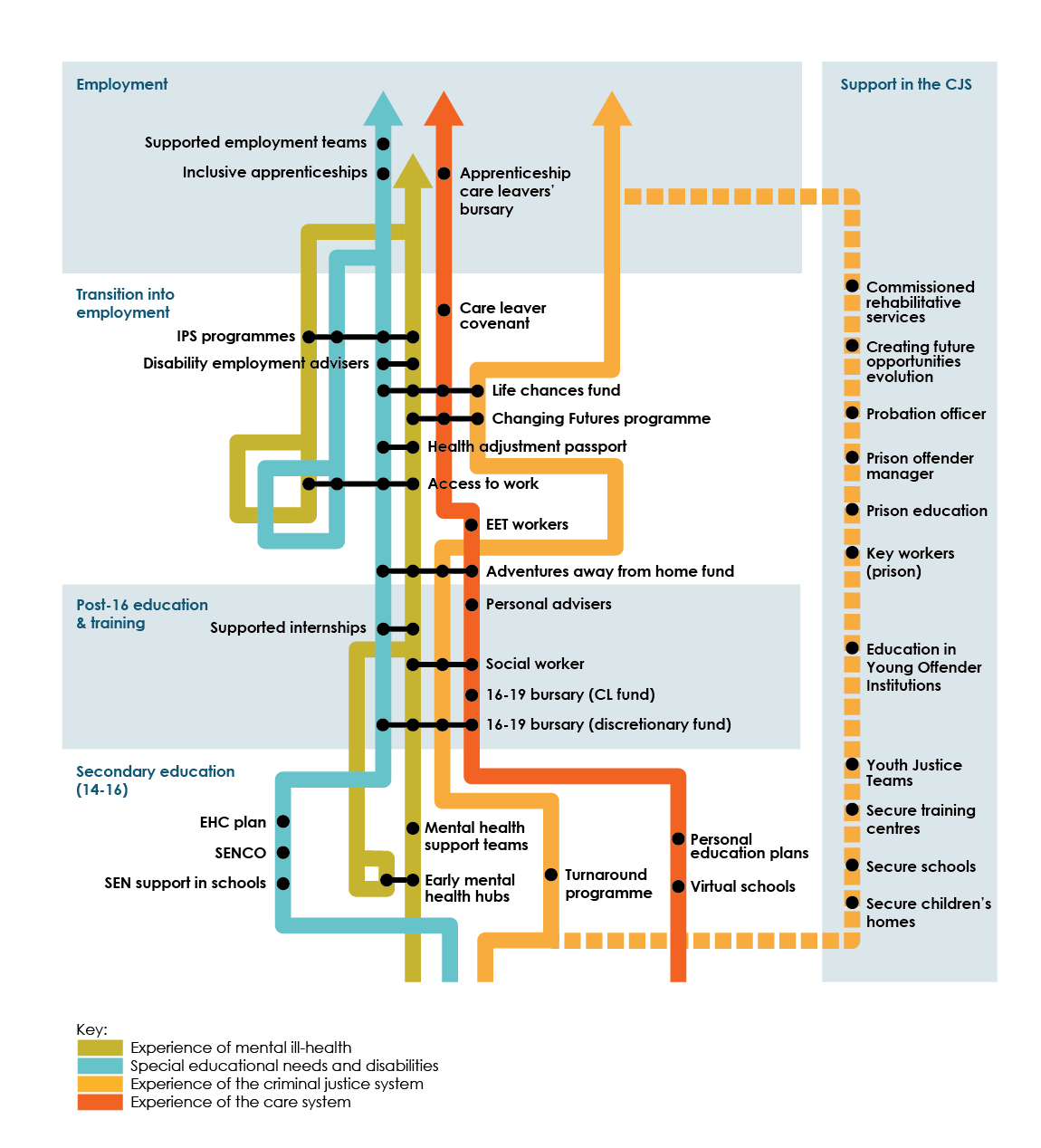
To do this, we commissioned the Institute for Employment Studies to map national, devolved, regional and local-level support systems in England for young people with:

  • special educational needs and disabilities
  • experience of the care system
  • mental ill-health
  • and/or experience of the criminal justice system

By highlighting the support landscape’s complexities and gaps, the report is intended to:

  1. help inform policymakers, funders and employers
  2. contribute to ongoing discussions around best practice in supporting marginalised groups of young people transition from employment and training into good work

The research looked at support that:

  • had at least some national government funding
  • targeted education to employment transitions
  • was available to people aged 14 to 30 years old in England in 2024

Emerging findings were shared with a Youth Advisory Group, and professionals working in these areas. Their reflections have informed this report.

Researchers conducted a deep-dive to map all available education-to-employment support for:

  • County Durham
  • Newcastle

The aim of the case studies was to identify the extent to which charity and community support was supplementing government-funded support.

Key insights

Existing conditions identified below create potential ‘postcode lotteries’ with support that is often short-term and difficult to navigate, leaving many young people facing confusing pathways, especially at key transition points.

The support landscape in England is complex

Read more about The support landscape in England is complex
  • 80 government-funded support mechanisms identified in 2024
  • Only 70 Early Mental Health Support Hubs were operating across England in 2024, illustrating variation of availability across local authorities
  • High turnover and resource pressures at delivery organisations undermine continuity
  • Support is often tied to a specific education provider, meaning new sources are needed at each transition point

Access can rely on:

  • Disclosure of personal or sensitive information, which can sometimes be a barrier
  • Diagnosis
  • Geography
  • The nature of contact with the criminal justice system
  • Knowledge of what existing support is available and how to access it
  • Navigating complex or lengthy processes such as education, health and care (EHC) assessments.

Uneven and fragmented provision means there are potential gaps

Read more about Uneven and fragmented provision means there are potential gaps

Research identified lack of support:

  • At transitions between education providers
  • That is available for flexible lengths of time (as opposed to ‘fixed length’ support)
  • That allows people multiple chances to engage
  • That supports care leavers beyond the age of 18

Implications

To build a more coherent, stable and equitable system, consideration must be paid to:

  • Centering young people’s lived experience in policy and practice
  • Balancing local flexibility with national consistency, ensuring that promising approaches to support can be scaled up, while ensuring responsiveness to local needs.
  • Investing in navigation support, workforce capacity and integrated provision

The Youth Guarantee Trailblazer place-based pilots offer a potential model for coordinated actions that include national strategy, local leadership and youth voice.

Want to read the full report?

Programme graphic
Questions about the publication?

If you have any questions or queries, please contact us

Questions graphic