Youth Employment Toolkit Toolkit resources

Filter by:

Reset filters
Impact on EducationEmploymentTraining
Evidence strength for EducationEmploymentTraining
How much does it cost?
How do we measure these?
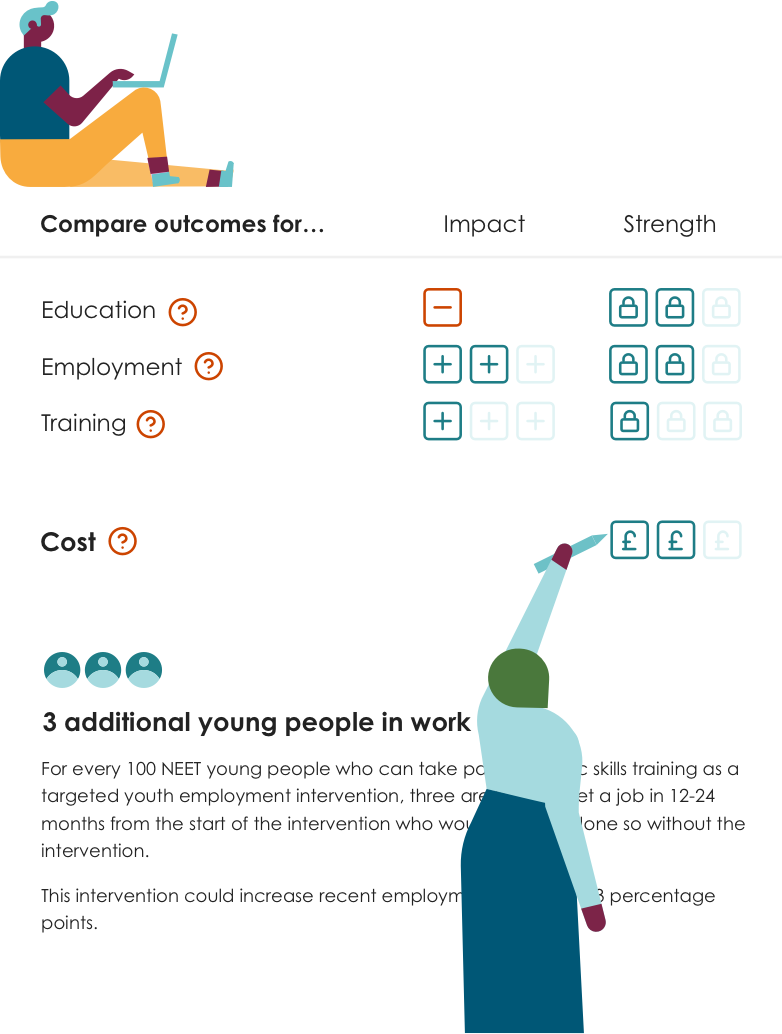
Compare Impact outcomes Reducing the UK's NEET rate is our north star goal. Interventions often perform differently across Employment, Education, and Training. Use these tabs to see where an intervention has the strongest Impact (the result) and the highest Evidence Strength (the quantity, nature and relevance of the underlying evidence for the result) to help you choose the right approach for your specific needs.
The headline measure for education is completing a ‘school leaving’ qualification by 24 months after the intervention starts. This corresponds broadly to passing GCSEs in England, or to Level 2 attainment, which is associated with lower risk of becoming NEET. Learn more
The headline measure for employment is whether a young person has been employed at any point in the 12-24 months after an intervention starts. Every young person has the right to earn, learn and thrive. Learn more
The headline measure for training is whether a young person has engaged with Technical and Vocational Education and Training (TVET) by 24 months after an intervention start, which can support the development of workforce skills and increase long-term earning and employment prospects. This is a composite of several outcome metrics. Learn more
Showing 17 interventions · Select an outcome to compare

Apprenticeships

Good-quality apprenticeships - delivered to those who are well-equipped to pursue them - can have a positive effect on employment, especially for young people from marginalised backgrounds.

Impact on Education score icon
Evidence strength for Education score icon
Impact on Employment score iconscore iconscore icon
Evidence strength for Employment score iconscore iconscore icon
Impact on Training score icon
Evidence strength for Training score icon
Cost score iconscore iconscore icon

Financial assistance

Financial assistance can improve employment for young people by reducing barriers to access and participation, and may support engagement in education and training.

Impact on Education score iconscore iconscore icon
Evidence strength for Education score iconscore iconscore icon
Impact on Employment score iconscore iconscore icon
Evidence strength for Employment score iconscore iconscore icon
Impact on Training score iconscore iconscore icon
Evidence strength for Training score iconscore iconscore icon
Cost score iconscore iconscore icon

Basic skills training

Basic skills training provides valuable underpinning for entry and progression in work and learning, and can be particularly effective in supporting apprenticeship participation.

Impact on Education score iconscore iconscore icon
Evidence strength for Education score iconscore iconscore icon
Impact on Employment score iconscore iconscore icon
Evidence strength for Employment score iconscore iconscore icon
Impact on Training score iconscore iconscore icon
Evidence strength for Training score iconscore iconscore icon
Cost score iconscore iconscore icon

Employment coaching

Employment coaching reduces the likelihood of young people being NEET by providing practical guidance on the job application process, and on starting a new job.

Impact on Education score icon
Evidence strength for Education score iconscore iconscore icon
Impact on Employment score iconscore iconscore icon
Evidence strength for Employment score iconscore iconscore icon
Impact on Training score icon
Evidence strength for Training score iconscore iconscore icon
Cost score iconscore iconscore icon

Behavioural skills training

Behavioural skills training provides valuable underpinning for entry and progression in work and learning. It may be particularly effective in supporting the completion of school leaving qualifications, as well as participation in apprenticeships.

Impact on Education score iconscore iconscore icon
Evidence strength for Education score iconscore iconscore icon
Impact on Employment score iconscore iconscore icon
Evidence strength for Employment score iconscore iconscore icon
Impact on Training score iconscore iconscore icon
Evidence strength for Training score iconscore iconscore icon
Cost score iconscore iconscore icon

Public works

Public works may reduce unemployment in periods of labour market distress, though impacts appear context-specific and warrant cautious interpretation.

Impact on Education score icon
Evidence strength for Education score icon
Impact on Employment score iconscore iconscore icon
Evidence strength for Employment score iconscore iconscore icon
Impact on Training score icon
Evidence strength for Training score icon
Cost score iconscore iconscore icon

Wage subsidies

The benefits of wage subsidies for youth employment outcomes tend to outweigh the costs, particularly for 18- to 24-year-olds and those facing the biggest barriers.

Impact on Education score iconscore iconscore icon
Evidence strength for Education score iconscore iconscore icon
Impact on Employment score iconscore iconscore icon
Evidence strength for Employment score iconscore iconscore icon
Impact on Training score icon
Evidence strength for Training score icon
Cost score iconscore iconscore icon

Summer jobs

Summer jobs can have positive impacts on education outcomes and personal development for young people and indirectly may also have positive impacts on youth employment outcomes over the longer term.

Impact on Education score icon
Evidence strength for Education score icon
Impact on Employment score iconscore iconscore icon
Evidence strength for Employment score iconscore iconscore icon
Impact on Training score icon
Evidence strength for Training score icon
Cost score iconscore iconscore icon

Employment counselling

Employment counselling supports young people to secure a job that is a good fit for them in the longer term and may also increase interest in higher education, by helping them to assess their skills and interests and explore suitable employment options.

Impact on Education score icon
Evidence strength for Education score iconscore iconscore icon
Impact on Employment score icon
Evidence strength for Employment score iconscore iconscore icon
Impact on Training score icon
Evidence strength for Training score iconscore iconscore icon
Cost score iconscore iconscore icon

Job search assistance

Job search assistance may increase participation in higher education, but has limited impacts on young people’s longer-term engagement in employment or vocational training.

Impact on Education score icon
Evidence strength for Education score iconscore iconscore icon
Impact on Employment score icon
Evidence strength for Employment score iconscore iconscore icon
Impact on Training score icon
Evidence strength for Training score iconscore iconscore icon
Cost score iconscore iconscore icon
Close Search interventions Search interventions

What is the toolkit?

The Toolkit is a free, online resource for anyone seeking evidence-based guidance on policy and practice. It is created by Youth Futures Foundation, the UK’s national What Works Centre for youth employment, and is based on a rigorous review of international evidence.

Toolkit disclaimer The Toolkit includes references to third party research and publications which Youth Futures Foundation is not responsible for, and cannot guarantee the accuracy of. View full disclaimer

View full disclaimer

While every effort has been made to ensure the accuracy of the information that the toolkit contains, Youth Futures Foundation makes no warranty (express or implied) regarding that information and does not accept responsibility for any errors, omissions, or misleading statements that the toolkit or the materials it refers to may contain.

The impact of any youth employment intervention depends on the context and quality of implementation, and if you use the Youth Employment Toolkit as the basis for an intervention, you should consider carefully how best to implement it in your particular circumstances.

You should also check that you are using the most up-to-date version of the Toolkit, as it will be updated on an ongoing basis as new information becomes available. As a consequence, Youth Futures Foundation does not accept responsibility for the outcomes or impacts of interventions planned using information from the Youth Employment Toolkit.

The Toolkit is not:

  • A comprehensive guide to all youth employment interventions. The first edition of the Toolkit includes evidence on seven different kinds of intervention. We know there are many others and we plan to add further sections over time.
  • A comprehensive guide to these interventions. The Toolkit summarises the best available evidence from published evaluations of these interventions, where they have been used in countries that are broadly comparable to the UK. However, if an intervention hasn’t been tried, or if it has been tried and not evaluated, or if its evaluation wasn’t published or didn’t meet the criteria for inclusion, then that limits the information that we can include in the Toolkit. We know that some interventions that are of great interest to people working on youth employment simply don’t have enough evidence for us to include (we’ll do our best to incorporate new evidence as it is published). We’ve tried to focus on the highest quality evidence available in our Toolkit, but this inevitably limits the number of studies that are included.
  • A comprehensive guide to the impacts of the interventions included in the Toolkit. The nature of the evidence that was available meant that the analysis for the Youth EmploymentToolkit could explore two kinds of outcome across the interventions, youth employment and education completion.
  • A guarantee, endorsement or quality assurance for anyparticular kind of intervention or example of an intervention or programme. The Toolkit sets out the best evidence for how interventions have worked in the past. How they work in the future will depend on a lot of factors including how they are implemented, and how they interact with their new context. And as fresh evidence gets published, that picture of how an intervention has previously worked could change as well.