Download
Authors

Gianfranco Addario, Charles Wilson, Joe Crowley, Sam Beardsworth, Lovisa Moller Vallgarda

Partners
https://youthfuturesfoundation.org/wp-content/uploads/2025/03/NatCen-logo.png
National Centre for Social Research

 · 

View bio
National Centre for Social Research
Research & evaluation partner

Programme

StatusActive

View partner View bio

About

NatCen is Britain’s largest independent not-for-profit social research organisation, working collaboratively to generate evidence that uncovers the reality of people’s lives in the UK.

Overview

In recent years, the number of young people spending time not in employment, education or training (NEET) has risen and now remains consistently high. This report summarises the development of an improved tool for the early identification of NEET risk, designed to be applied earlier in the school journey and implemented using only routinely collected administrative data. This makes the approach feasible to roll out at scale across England.
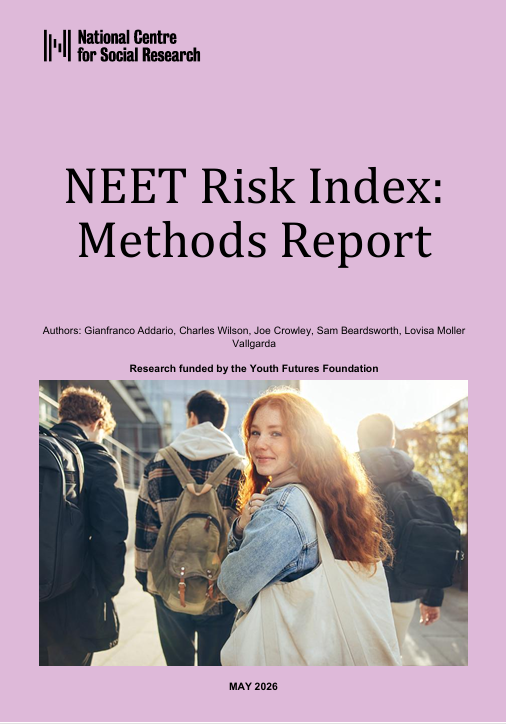
Building on previous research by the National Centre for Social Research into NEET risk factors, and on Blackpool Council’s practical experience of implementing a similar tool, the project aims to produce a more accurate, earlier‑warning measure of NEET risk that local authorities and schools can use without additional data collection.

Designing an enhanced RONI tool

Read more about Designing an enhanced RONI tool

This project set out to develop an enhanced RONI tool to provide a more nuanced approach to understanding a young person’s risk of becoming NEET by showing how much different indicators matter. By developing an evidence-based tool for identifying and weighting relative risk indicators, this research complements and enhances existing frameworks, including DfE’s RONI framework.

To achieve this, a statistical model was built using data from over one million children in England who left school between 2010 and 2012. The model estimates how each risk factor—such as school absence, Free School Meal eligibility, academic attainment, and type of Special Educational Needs— affects the likelihood of experiencing at least one 12-month period out of education, employment, or training between the ages of 16 and 24.

The information can then be used alongside pupil level data to generate a scaled risk score from 0 to 100, reflecting a young person’s likelihood of becoming NEET- thus supporting practitioners to identify emerging vulnerabilities early, target resources where they are most needed, and offer support before young people spend long periods out of education or work.

The most influential risk factors identified through building the updated NERI (NEET Early Risk Index) tool, were:

  • Educational attainment emerged as the strongest predictor of a young person becoming NEET. Young people who did not achieve any GCSEs were over five times more likely to experience a period NEET than those who achieved five or more A*–C grades. 
  • Socio-economic disadvantage plays a key role. Accounting for other factors in Year 11, young adults eligible for FSM for 1–2 years were 1.8 times more likely to experience NEET, rising to 2.2 times for those eligible for 3+ years. 
  • Special Educational Needs (SEN) presents a complex pattern of NEET risk, varying by type of need. 

Want to read the full report?

Programme graphic
Questions about the publication?

If you have any questions or queries, please contact us

Questions graphic