
News, Policy hub
Introducing our updated and expanded Youth Employment Toolkit
Sep 08, 26
Sep 08, 26
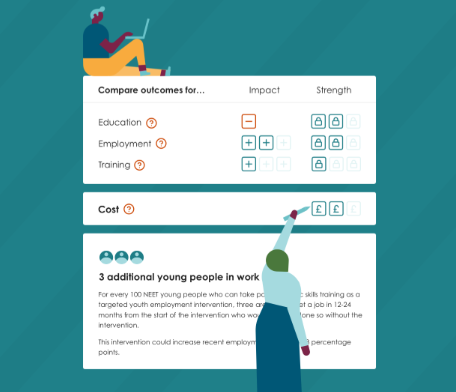
The new edition offers accessible and usable insights on common youth employment interventions and their components to help support decision-makers improve the lives of young people.
Our Youth Employment Toolkit is designed to help answer a simple but crucial question: Does this intervention make a difference?
To do this, it:
By translating complex evidence into actionable insights, the Toolkit bridges the gap between research and real-world application, making it easier for decision-makers to quickly and confidently access credible information.
Anyone involved in commissioning, designing and evaluating programmes to support youth employment can use the Toolkit to compare insights on the impact of common intervention types and specific components and understand where impact is most likely.
The evidence can be used to inform existing and new youth employment interventions, helping ensure investment is made in effective, scalable, and meaningful solutions to help tackle the persistent and systematic challenge facing young people in the UK.
The first edition, launched in 2023, presented information on seven common intervention types designed to improve employment outcomes for young people.
Three years on, the evidence base has grown significantly, as has the demand for clear and robust insights to help tackle the persistent NEET challenge.
The foundation remains unchanged: a commitment to international, high-quality youth employment evidence grounded in a comprehensive meta-analysis of impact evaluations.
The Toolkit continues to focus on effectiveness, providing comparative insights across common intervention types and individual components, as well as an indication of associated costs and implementation considerations.
The new edition includes updated evidence on 15 commonly-used components of active labour market programmes across skills development and employment support.
These insights are presented alongside the robust findings on apprenticeships and summer jobs from the first edition of the Toolkit.
| Type | Specific component | Status |
|---|---|---|
| Employment support services | Employment coaching | New |
| Employment counselling | New | |
| Financial assistance | New | |
| Job search preparation | New | |
| Job search assistance | New | |
| Employment experience | Apprenticeships | As edition 1 |
| On-the-job training | Updated | |
| Paid temporary work experience | New | |
| Summer jobs | As edition 1 | |
| Unpaid temporary work experience | New | |
| Self-employment support | Combined insights on business skills training, advice and mentoring, and financial and start-up support) | New |
| Subsidised support | Wage subsidies | Updated |
| Public works | New | |
| Skills development | Basic skills training | Updated |
| Soft skills training (formerly life skills) | Updated | |
| Behavioural skills training (formerly life skills) | New | |
| Off-the-job training | Updated |
The latest version also looks at a wider range of primary outcomes than the first edition, adding education and training metrics alongside impact on employment, recognising the interconnected nature of pathways into work. Additionally, it offers emerging data on the impact of components on the NEET rate.
The update also provides findings about work quality where available, including job duration, hours worked, and pay, crucial to understanding how to support young people into secure and meaningful employment.
All outcomes are standardised at 24 months following the start of a youth employment intervention, rather than ‘at any point’. This offers a clearer and more consistent picture of how interventions support young people to build the skills, knowledge and capacity for learning and earning and achieve stable, good-quality employment throughout their adult lives.
As a result, users will see some differences between the latest headline figures and those presented in the first edition. If more young people are learning or training, that may mean that fewer are in employment at 24 months. But they are building a foundation for their future working lives.
For example, in countries like the Netherlands that have lower NEET rates than the UK we see higher engagement in vocational learning between the ages of 16 and 24 which is associated with better employment outcomes.
Further improvements to the Toolkit include a more sophisticated categorisation system for impact and evidence-strength ratings.
At its core is a new, robust quantitative component network meta-analysis of impact evaluations, which adopts a Bayesian analytical approach. This offers probabilities of impact across different levels, rather than single-point estimates used in the first edition, providing a more nuanced and realistic picture of the expected impacts particularly where evidence is complex or findings are varied.
Alongside this are insights from implementation and process evaluations.
“The newly updated Youth Employment Toolkit is more aligned with real-world decision-making, offering clearer, richer insight into what works and with what level of confidence.
“It gives those spending money and shaping strategies a better sense of the likelihood, scale, and variation of impact to better achieve deep, long-term change for young people.”
Chris Goulden, Interim Deputy CEO and Director of Impact & Evidence at Youth Futures