Download
Authors

Joanna Hofman, Facundo Herrera, Oliver Tee, Nicola de Waal, Marina Leoni, Juliet Snell, Dani Stern, Adam Whitworth, Michael Vallely

Overview

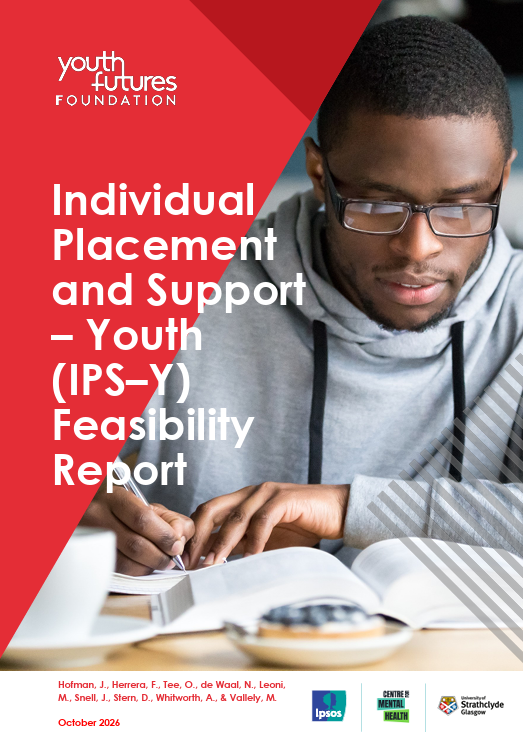
Existing international evidence indicates that Individual Placement and Support – Youth (IPS-Y) models which integrate education, employment and vocational support within mental health services can have positive impacts on employment and education outcomes for young people with mental health difficulties.

To understand more about the impact of these models in England, we commissioned Ipsos, University of Strathclyde and Centre for Mental Health to conduct a feasibility study of IPS-Y across two NHS trusts in Greater Manchester.

The study looked at:

  • The participating NHS trusts’ readiness and commitment to participating in a trial
  • The delivery partner and NHS trusts’ ability to deliver the intervention
  • How the programme was perceived by stakeholders
  • The programme’s suitability for a randomised controlled trial

The resulting report details the study, key insights and next steps.

Designed specifically for young people, Individual Placement and Support – Youth (IPS-Y)is an adaptation of the evidence-based IPS model that integrates education, employment and vocational support within mental health services.

It combines personalised vocational support with ongoing Child and Adolescent Mental Health Services (CAMHS) care, aiming to help young people access and sustain meaningful education, training and employment opportunities as part of their recovery.

Key insights

Overall, progression to a full-scale trial is feasible and justified, subject to completion of key set-up activities and successful achievement of pilot progression criteria.

While uncertainties remain around recruitment, retention, governance approvals and implementation mobilisation, these were considered manageable and appropriate for testing through a nested internal pilot.

There was sufficient support and demand for IPS-Y and the conditions necessary for the successful completion of a randomised controlled trial were broadly met.

Specifically:

  • the number of young people receiving treatment through participating Child and Adolescent Mental Health (CAMHS) services appears large enough to support recruitment to a future trial – although the proportion of young people who meet eligibility criteria, express interest in education and employment support, consent to participate and remain engaged remains uncertainmanageable and appropriate for testing through a nested internal pilot. The overall conclusion was that progression to a full-scale trial is feasible and justified, subject to completion of key set-up activities and successful achievement of pilot progression criteria
  • delivery partners and NHS trusts were found to have the capability and infrastructure to deliver the intervention
  • while consent and randomisation procedures were deemed feasible and ethical, young people highlighted the need for clear, accessible and youth-friendly communication, including plain-English information materials, visually engaging content, opportunities to access information independently through digital platforms, and multiple opportunities to ask questions before deciding whether to participate
  • while a number of employment, education and IPS-based services are available locally, stakeholders deemed IPS-Y distinct enough from existing provision to enable a meaningful assessment of its impact
  • young people’s engagement and retention were considered feasible, provided that youth-centred and neurodiversity and trauma-informed approaches are adopted.

A key strength of the study was its collaborative and co-designed approach, particularly the involvement of young people and parents/carers in shaping the proposed trial design.

Limitations included uneven engagement across NHS Trusts, variable quality of administrative data, and reliance on stakeholder views in areas where direct implementation evidence was not yet available.

The study explored key aspects of trial readiness, including recruitment, randomisation, implementation capacity, outcome measurement, participant retention, governance and safeguarding arrangements through:

  • quantitative and qualitative evidence gathering (desk research, administrative data analysis)
  • extensive stakeholder engagement (interviews, workshops, co-designed activities) with NHS Trusts, delivery partners, young people, partners and carers, and system actors

Findings were synthesised using a triangulation approach, bringing together evidence from multiple sources and perspectives.

Feasibility dimensions were assessed against predefined criteria and assigned a Red, Amber or Green (RAG) rating to indicate readiness for progression to a future trial.

The assessment considered both the strength of the available evidence and the extent to which identified challenges could be addressed before implementation.

Next steps

We are proceeding with a pilot randomised controlled trial of IPS-Y in Greater Manchester.

The design and delivery for the pilot RCT will be informed by learnings and insights from the feasibility report and will explore whether key trial design features work in practice.

Want to read the full evaluation report?

More about the programme

Check out more of what we’ve acheived with IPS-Y impact evaluation

IPS-Y impact evaluation
Programme graphic
Questions about the publication?

If you have any questions or queries, please contact us

Questions graphic