
Policy papers, Summaries
Sep 2026
Briefing: Intro to component network meta analysis
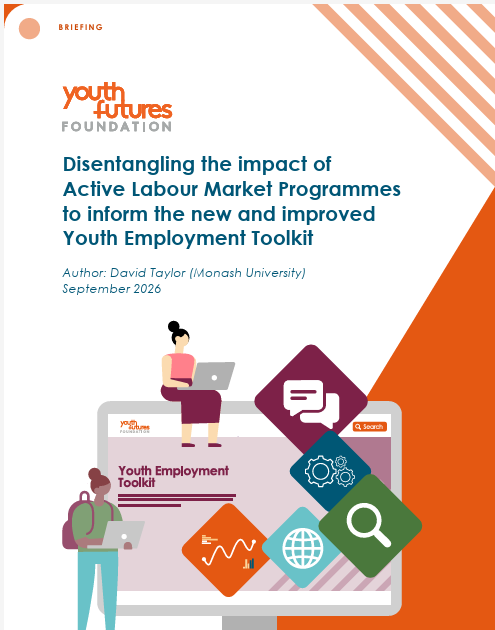
Disentangling the impact of Active Labour Market Programmes to inform the new and improved Youth Employment Toolkit

Evidence and Research on Youth Employment, Evidence into Action ·
View bio

What Works: testing youth employment interventions ·
View bio

Summarising evidence on effective youth employment interventions.
View toolIn 2021 Youth Futures Foundation engaged a consortium from Monash University, the Centre for Evidence and Implementation, and the Institute for Employment Studies to make sense of the existing research on which interventions help young people enter the labour market.
The research was used to inform the Youth Employment Toolkit, a digital resource translating evidence into practical information for decisionmakers, first launched in 2023.
In 2026 the Toolkit was updated and expanded, using new analysis to help untangle ‘what works’ for youth employment.
This short briefing explains what’s changed in the second edition of the Toolkit, what’s improved and why it matters.
All of this work feeds back into providing actionable evidence to inform practice. The new analysis underpins an update to the Youth Employment Toolkit which speaks to a richer set of programme components, and a wider range of outcomes, than the first edition could reach. Learn more about the latest edition.
Addressing barriers and reinforcing facilitators is critical to improving the impact and delivery of youth employment interventions and initiatives. To be effective, and reach those who need it most, programmes and interventions need:
Many employment interventions encounter challenges in recruiting and retaining the most marginalised young people, suggesting those furthest from the labour market are at a particular risk of not receiving support. When engaged, these groups often see the greatest benefit. Reaching the most disadvantaged requires deliberate focus in programme design.
This includes piloting, and possibly a staggered rollout. If programmes are to scale successfully, it is crucial that they are informed by a clear evidence pipeline, starting with formative evaluation through a pilot, followed by efficacy trials, and then effectiveness studies, to ensure they are tested, adapted, and informed by what works.
Young people furthest from the labour market often face complex challenges, such as health issues, unstable housing or low education. Customised support and access to relevant services is necessary. Personalised support requires flexibility, a wide range of options and support for community organisations to improve accessibility.
To sustain programmes and interventions it is important that they have the resources for successful implementation.
While central government can set out the overall strategic direction of youth employment, local approaches will be pivotal in providing tailored customised support.
Insights from this review can support strategic authorities and national government to consider design and implementation barriers and facilitators for the ‘Youth Guarantee’ trailblazers initiative pilot and national rollout, particularly around delivery and working collaboratively in local areas.
Policymakers at all levels can draw learning about how to build in systems of evidence, data and continuous learning to improve future iterations of programmes, and new provision.
For national policy makers the report can support considerations around ensuring there is foundations in place to gain maximised learning from their implementation to inform next steps.
The government has made a commitment that all school and college students will receive a two-week (50 hours) work experience entitlement to boost employability skills.
This report provides policymakers with an overview of previous work experience programmes, including information about effective design and implementation, and how to use existing systems, develop partnerships with employers, and tackle barriers and facilitators to employer participation.
This report provides perspectives on what effective non-apprenticeship training looks like and can inform what types of programmes should be available via the new, more flexible levy.
Policymakers can also use this report to gain an historical overview of apprenticeship employment programmes, plan the delivery of the new levy, and consider factors that have impacted the delivery of previous apprenticeship programmes.
Check out more of what we’ve acheived with Evidence and research on youth employment
Evidence and research on youth employment
If you have any questions or queries, please contact us