Download
Authors

David Taylor, Katherine Young, Becci Newton, Emily Tanner-Smith, Aron Shlonsky

Partners
https://youthfuturesfoundation.org/wp-content/uploads/2025/04/Monash-University-logo.png
Monash University

Evidence and Research on Youth Employment  · 

View bio
Monash University
Research & evaluation partner

ProgrammeEvidence and Research on Youth Employment

StatusActive

View partner View bio

About

Monash University, Australia’s largest university, is ranked in the world’s top 100 and is a member of the prestigious Group of Eight. It is widely recognised as one of the most international universities globally.

Data Matters is a research unit within the Department of Social Work, led by Professor Aron Shlonsky. The multidisciplinary team of social welfare researchers, quantitative analysts and engineers uses data-driven approaches to support evidence-informed social services. It brings together content knowledge and technical expertise across a range of social service contexts, including the use of administrative data.

Capabilities span experimental and quasi-experimental designs, systematic reviews and meta-analyses, predictive modelling, and measuring implementation processes and outcomes. Data Matters partners with government as well as philanthropic and research organisations in their efforts to improve decision making and service delivery.

https://youthfuturesfoundation.org/wp-content/uploads/2025/04/CEI-logo.jpg
Centre for Evidence and Implementation

Evidence and Research on Youth Employment, Evidence into Action  · 

View bio
Centre for Evidence and Implementation
Evaluation panel, Learning partner, Research & evaluation partner

ProgrammeEvidence and Research on Youth Employment, Evidence into Action

StatusActive

View partner View bio

About

CEI is a global, independent nonprofit dedicated to using the best evidence to improve the lives of children, families, and communities facing adversity. CEI’s international team of researchers and implementation specialists partner with what works centres, organisational leaders and teams, practitioners and policymakers on rigorous evaluation, evidence-informed programme design, and effective implementation and scaling.

Working with Youth Futures

CEI collaborates with us on research and evaluation activity as a member of our evaluation panel.

As Practice Development and Implementation Partner for Evidence into Action, CEI’s primary role is to synthesise and translate current evidence available on On/Off the job training and support delivery partners to apply evidence into existing or pilot programmes and embed and sustain evidence-based practice approaches.

https://youthfuturesfoundation.org/wp-content/uploads/2025/04/Institute-for-Employment-Studies-logo.png
Institute for Employment Studies (IES)

What Works: testing youth employment interventions  · 

View bio
Institute for Employment Studies (IES)
Evaluation panel, Research & evaluation partner

ProgrammeWhat Works: testing youth employment interventions

StatusActive

View partner View bio

About

IES is a leading independent centre for applied research and insight on employment, workforce, and labour markets.

Its mission is to help bring about sustainable improvements in employment policy and human resource management by generating and applying the best evidence to build a more inclusive, healthier and empowering world of work. It develops insight on what works across the employment journey – from education and transitions into work, through to workforce management, development, and careers.

Working with Youth Futures

IES collaborates with us on research and evaluation activity as a member of our evaluation panel.

Youth Employment Toolkit

Summarising evidence on effective youth employment interventions.

View tool

Summary

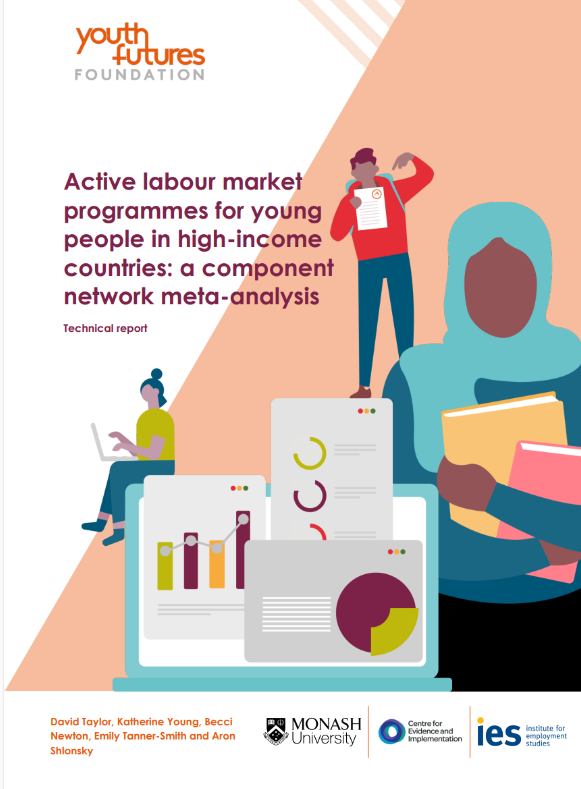
Youth Futures Foundation commissioned the Centre for Evidence and Implementation, the Institute for Employment Studies and Monash University to synthesise existing evidence on active labour market programmes (ALMPs).

The aim was to assess the impact of individual components of ALMPs on employment, education and training outcomes for young people (aged 15-35) in high-income countries, compared to service as usual.

The report presents insights on 15 individual components, across a range of quantitative outcomes. The findings substantially extend the range of measures and outcomes covered in the Youth Employment Toolkit.

Approach

Learn more about search strategy and inclusion criteriaRead more about Approach

The review draws on several high-quality reviews to identify eligible studies published between 1990 and October 2023:

  • a systematic review by Puerto et al. (2022)
  • the evidence and gap map by Apunyo et al. (2022)
  • a review by Kluve et al. (2017)

Supplementary searches screened grey literature.

The approach is designed to maximise the number of studies that could be include in analysis while minimising any bias that it introduced.

Inclusion criteria

Studies where the comparison group is provided with usual services, no intervention, other services, or wait-list control.

Studies were not required to include a usual services arm; studies directly comparing two or more eligible ALMP components or component combinations were eligible.

Studies that reported a quantitative measure of:

  • Employment
  • Earning
  • Business performance
  • Education and skills
  • Social networks and relationships
  • Physical and mental health
Included studies
  • 272 reports, representing 286 unique studies
  • Almost half (46%) of studies were conducted in the United States (n=72)
  • Almost half (46%) of the studies were randomised controlled trials (n=72).
  • Around 10% were conducted in the UK (n=17)

See pages 55-57 for further details.

Included components

15 components delivered as part of an evaluated youth employment programmesRead more about Included components
  1. Basic skills training
  2. Soft skills training
  3. Behavioural skills training
  4. Off-the-job job-specific technical skills training
  5. On-the-job job-specific technical skills training
  6. Self-employment support
  7. Job search preparation
  8. Job search assistance
  9. Employment counselling
  10.  Employment coaching
  11.  Financial assistance
  12.  Paid temporary work experience
  13.  Unpaid temporary work experience
  14.  Wage subsidies
  15.  Public works

The structure and definitions of these components build on those underpinning the Puerto et al (2022) systematic review of the Impact of Active Labour Market Programmes on Youth Employment.

See Table 16 on pages 23-32 for full intervention and component definitions.

Taxonomy of outcomes

Grouped by seven domainsRead more about Taxonomy of outcomes
  1. Labour Force Status — Indicators of an individual’s employment status, measured as current, recent (up to ≤12 months recall) status, or “ever since baseline”.
  2. Employment Compensation — Monetary returns conditional on being employed, including wages, salary, and cumulative pay.
  3. Employment Duration — Cumulative time spent in employment during the follow-up
    window.
  4. Hours Worked — Indicators of employment intensity, measured weekly or monthly.
  5. Total Income — Broad measures of resources available to individuals or households, combining labour and non-labour sources e.g., earnings and transfers.
  6. Labour Market Transitions — Measures of flows into or out of labour force states, such as entries to employment, exits from unemployment or not in the labour force.
  7. Education and Skills — Measures of human capital accumulation, including enrolment, participation, and completion by ISCED levels; apprenticeship

See Table 18 on page 41 for more detail.

Statistical analysis

Overview of the quantitative synthesis undertaken and how it can be interpretedRead more about Statistical analysis

The review uses a multivariate hierarchical Bayesian component network meta-analysis (CNMA).

The method used offers an account of the probability of each level of impact, as well as a ‘headline’ median estimate.

The actual identified impact of any programme depends on how and when it is implemented, and the approach to evaluation.

See pages 50-51 for further details on interpretation.

Headline insights

Here we present an overview of key findings by headline outcomes. For full component-specific analysis view the full report.

Median impacts are generally low to moderate and cumulative

Read more about Median impacts are generally low to moderate and cumulative

The median impacts on employment, education and training that are associated with the components are mostly low or moderate. This is in line with the first edition of the Youth Employment Toolkit and other international meta-analyses.

Reported impacts are associated with individual components of youth employment programmes.

To estimate the possible impact of a programme on any outcome, users can add the impacts of all the components that it includes.

Which components are likely to have a positive impact on employment?

Read more about Which components are likely to have a positive impact on employment?

Basic skills training and financial assistance are associated with ‘moderate’ median impact on employment between 12 and 24 months after starting an intervention (‘recent employment’).

Wage subsidies and employment coaching are associated with a median impact in the ‘low positive’ range.

The evidence for associated impacts on NEET at 24 months after starting an intervention is mostly ‘emerging’ (very few evaluations measure this outcome).

Off-the-job training, job search preparation, employment coaching and unpaid work experience are associated with the moderate or high median impacts, on the basis of this limited evidence.

On-the-job training and wage subsidies are associated with median impacts in the ‘low positive’ range.

Which components are likely to have a positive impact on education?

Read more about Which components are likely to have a positive impact on education?

Behavioural skills training, off-the-job training and wage subsidies are associated with median impacts in the ‘moderate positive’ or ‘high positive’ ranges for attaining a Level 2 qualification (‘school completion’).

Soft skills training, unpaid work experience and financial assistance are associated with median impacts in the ‘low positive’ range.

Which components are likely to have a positive impact on training?

Read more about Which components are likely to have a positive impact on training?

Off-the-job training is associated with a ‘moderate positive’ median impact across a range of technical and vocational education and training (TVET) outcomes.

Basic skills training, soft skills training, behavioural skills training, on-the-job training, financial assistance and job search preparation associated with a ‘low positive’ median impact on TVET outcomes.

Which components are likely to have a positive impact on work quality?

Read more about Which components are likely to have a positive impact on work quality?

Behavioural, ‘soft’ and basic skills training, off-the-job training and on-the-job training, and basic skills training are associated with positive median impacts across several work quality measures.

Other interventions are associated positive median impacts on individual aspects of work quality.

Do impacts vary for different ages within the 16-24 age group?

Read more about Do impacts vary for different ages within the 16-24 age group?

Median impacts may be higher for ‘older’ young people for off-the-job training, wage subsidies, ‘soft’ skills training, employment counselling, job search assistance, job search preparation, and financial assistance.

Median impacts may be higher for ‘younger’ young people for basic skills training.

Next steps

The current findings represent a foundation from which more granular analyses can be developed.

There is significant scope to use the existing network to explore impacts for different socio-demographic groups and test specific hypotheses regarding the interaction between components.

The stability of these estimates remains to be tested against critical moderators including macro-economic contexts such as business cycle dynamics.

Want to read the full report?

Programme graphic
Questions about the publication?

If you have any questions or queries, please contact us

Questions graphic