Download
Authors

S. Smith, E. Santana de Lima, G. Kembhavi-Tam, C. Preece, P. Verdugo, A. Hall, J. Rowland, F. Green, J. Harris, J. Lewis

Partners
https://youthfuturesfoundation.org/wp-content/uploads/2025/09/Dartington_Logo-Bright-RGB.svg
Dartington Service Design Lab

What Works: testing youth employment interventions  · 

View bio
Dartington Service Design Lab
Evaluation panel, Research & evaluation partner

ProgrammeWhat Works: testing youth employment interventions

StatusActive

View partner View bio

About

Dartington Service Design Lab is a research charity.

Working with Youth Futures

Dartington Service Design Lab collaborates with us on research and evaluation activity as a member of our evaluation panel.

Currently, it one of the evaluation partners for our What Works: testing youth employment interventions programme.

https://youthfuturesfoundation.org/wp-content/uploads/2025/04/CEI-logo.jpg
Centre for Evidence and Implementation

Evidence and Research on Youth Employment, Evidence into Action  · 

View bio
Centre for Evidence and Implementation
Evaluation panel, Learning partner, Research & evaluation partner

ProgrammeEvidence and Research on Youth Employment, Evidence into Action

StatusActive

View partner View bio

About

CEI is a global, independent nonprofit dedicated to using the best evidence to improve the lives of children, families, and communities facing adversity. CEI’s international team of researchers and implementation specialists partner with what works centres, organisational leaders and teams, practitioners and policymakers on rigorous evaluation, evidence-informed programme design, and effective implementation and scaling.

Working with Youth Futures

CEI collaborates with us on research and evaluation activity as a member of our evaluation panel.

As Practice Development and Implementation Partner for Evidence into Action, CEI’s primary role is to synthesise and translate current evidence available on On/Off the job training and support delivery partners to apply evidence into existing or pilot programmes and embed and sustain evidence-based practice approaches.

Overview

Implementation and Programme theories are essential to uncovering ‘what works, for whom, under what conditions’.

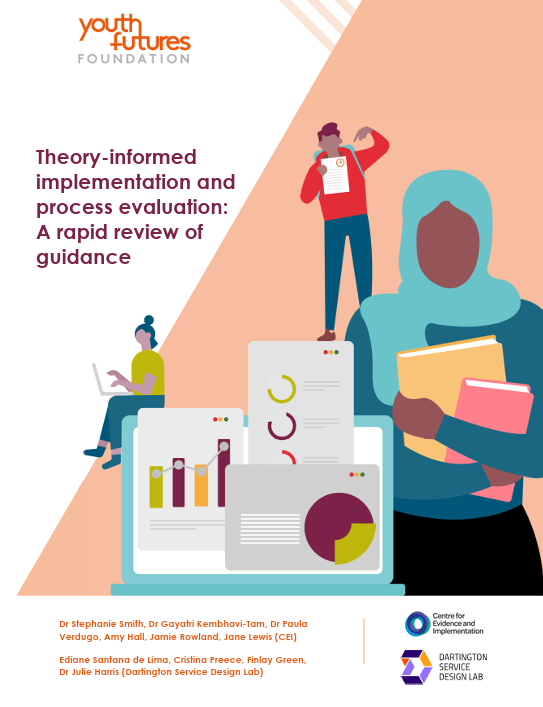
To support the creation of guidance for valuators undertaking Theory-Informed Implementation and Process Evaluations (TIIPEs) for Youth Futures Foundation, CEI, Dartington, Friendhood conducted a rapid evidence review and expert consultation.

This report describes the approach taken and synthesises the evidence reviewed.

Research questions

  1. How is TIIPE defined and its function in different evaluation contexts described?
  2. How should evaluators approach the development, testing and refinement of programme theory and implementation theory?
  3. How should evaluators design evaluations to test programme theory and implementation theory, at different stages of evaluation and in different contexts?
  4. How has TIIPE been undertaken in evaluations of interventions to support the employment of marginalised young people?

What is programme theory?

Read more about What is programme theory?

Programme theory articulates the hypothesised causal pathways through which activities are expected to lead to desired outcomes, including describing the underlying assumptions that link inputs, mechanisms, and impacts.

What is implementation theory?

Read more about What is implementation theory?

Implementation theory outlines the contextual factors and conditions required for a programme to be delivered as intended – and therefore for the programme theory to have a realistic chance of playing out in practice.

Contents

Chapter 1 – Introduction

Chapter 2 – Search strategy, eligibility criteria, and approach to screening and extraction

Chapters 3 to 6 – Research questions 1-3

Chapter 3 – Key definitions and concepts relating to TIIPE adopted in the reviewed studies

Chapter 4 – How to develop, test and refine theory in TIIPE

Chapter 5 – Equity in TIIPE

Chapter 6 – How the focus of TIIPE changes at different stages of evaluation

Chapter 7 – Overview of how theory was incorporated in the selected individual evaluations of initiatives to support marginalised young people into work

Chapter 8 – Discussion

Method

The authors examine the existing literature through a dual-theory lens.

The approach included:

  • searching within academic databases with tight search terms and parameters
  • a targeted website search for grey literature
  • consultation with experts in the field
  • exploration of Youth Futures’ published IPEs and Evidence Gap Map, with additional texts included to fill gaps that emerged in synthesis

Want to read the full publication?

Questions about the publication?

If you have any questions or queries, please contact us

Questions graphic